We're #1!...
-
AZGrizFan

- Supporter

- Posts: 59959
- Joined: Fri Jul 13, 2007 4:40 pm
- I am a fan of: Sexual Chocolate
- Location: Just to the right of center
Re: We're #1!...
Our middle class today looks NOTHING like the middle class of 20, 30 or 40 years ago. Today's middle class would be looked at as 1%'ers by the middle class of 1965.
"Ah fuck. You are right." KYJelly, 11/6/12
"The future must not belong to those who slander the prophet of Islam." Barack Obama, 9/25/12

"The future must not belong to those who slander the prophet of Islam." Barack Obama, 9/25/12
-
kalm
- Supporter
- Posts: 69973
- Joined: Thu Oct 01, 2009 3:36 pm
- I am a fan of: Eastern
- A.K.A.: Humus The Proud
- Location: Northern Palouse
Re: We're #1!...
Again, fully agreeing there are multiple factors (dot.com boom anyone?), but Clinton raised taxes on the rich, created more jobs than Reagan and Bush 1 combined, and lowered the deficit.OL FU wrote:89Hen wrote: I guess I was right in what you propose.
and I think the question isn't whether there is a trickle down with lower taxes on the rich, the question is will imposing higher taxes on the rich trickle down.
Back to the original article and regardless, our middle class is getting passed up by countries who tax the wealthy and corporations at a higher effective rate, while spending more on educational and child care subsidies, and regulating industries at least equal if not more. I'm really not too worried about our top 10%…they'll find a way to squeak by. But I agree with Joltin Joe and others that we need to find ways to boost the middle class.


-
kalm
- Supporter
- Posts: 69973
- Joined: Thu Oct 01, 2009 3:36 pm
- I am a fan of: Eastern
- A.K.A.: Humus The Proud
- Location: Northern Palouse
Re: We're #1!...
So would the middle class in Canada and Sweden who we're comparing to here.AZGrizFan wrote:Our middle class today looks NOTHING like the middle class of 20, 30 or 40 years ago. Today's middle class would be looked at as 1%'ers by the middle class of 1965.
Middle class envy….

-
kalm
- Supporter
- Posts: 69973
- Joined: Thu Oct 01, 2009 3:36 pm
- I am a fan of: Eastern
- A.K.A.: Humus The Proud
- Location: Northern Palouse
Re: We're #1!...
I like your thoughts here Joe, but I'm not sure the government picking winners and losers and complicating the tax code further is the answer.JoltinJoe wrote:See, we can get along.houndawg wrote:
This.
The country peaked for the middle class in the early 70s before everybody's mom had to go to work so the family could make ends meet.
In order to correct this problem, our federal government needs to do the following:
(i) Reform the tax code significantly; cut the tax burden on the middle class, without increasing the tax burden on the investment class.
(ii) Provide significant tax code incentives for the creation and maintenance of manufacturing jobs in targeted industries.
(iii) Significantly cut federal spending, including defense and social entitlement programs. Our national debt is nearly 100% of GDP. While that is not an all-time high, it is way above historical norms. We need a serious plan to reduce debt to about 40% of GDP and accomplish that within a decade.

-
kalm
- Supporter
- Posts: 69973
- Joined: Thu Oct 01, 2009 3:36 pm
- I am a fan of: Eastern
- A.K.A.: Humus The Proud
- Location: Northern Palouse
Re: We're #1!...
Kalm reports…you decide.89Hen wrote:I guess I was right in what you propose.kalm wrote:Bottom line, we still have relatively low tax rates, relatively low levels of regulation, relatively low levels of education and child care subsidies and a thriving upper class that has benefited immensely from these policies which is supposed to spread the wealth downward. They've had 30 years to do this.

-
kalm
- Supporter
- Posts: 69973
- Joined: Thu Oct 01, 2009 3:36 pm
- I am a fan of: Eastern
- A.K.A.: Humus The Proud
- Location: Northern Palouse
Re: We're #1!...
So you're saying regulations in Canada, the UK, and Sweden are less?BDKJMU wrote:kalm wrote:
OLFU:
The study goes back 35 years. The middle class could have been in decline before that. In fact the article does cite Harvard economist Lawrence Katz who states that we have been in decline since 1960. And yes, some of this decline can be attributed to post WWII competitive advantages we had over other countries and the inevitability of those countries catching up.
But the rate of decline of the lower classes has certainly trended ever more downward since 1980 and the wealth in the highest brackets has increased while productivity from those lower classes has also increased.
You are correct regarding Supply Side being about more than tax rates, and we went through a massive deregulatory period of the financial industry in the late 1990's.
Bottom line, we still have relatively low tax rates, relatively low levels of regulation, relatively low levels of education and child care subsidies and a thriving upper class that has benefited immensely from these policies which is supposed to spread the wealth downward. They've had 30 years to do this.
(Hint…that's what we're talking about here.)
-
OL FU
- Level3

- Posts: 4336
- Joined: Mon Jul 16, 2007 12:25 pm
- I am a fan of: Furman
- Location: Greenville SC
Re: We're #1!...
kalm wrote:Again, fully agreeing there are multiple factors (dot.com boom anyone?), but Clinton raised taxes on the rich, created more jobs than Reagan and Bush 1 combined, and lowered the deficit.OL FU wrote:
and I think the question isn't whether there is a trickle down with lower taxes on the rich, the question is will imposing higher taxes on the rich trickle down.
Back to the original article and regardless, our middle class is getting passed up by countries who tax the wealthy and corporations at a higher effective rate, while spending more on educational and child care subsidies, and regulating industries at least equal if not more. I'm really not too worried about our top 10%…they'll find a way to squeak by. But I agree with Joltin Joe and others that we need to find ways to boost the middle class.
and Clinton lowered capital gains which effectively lowered the very wealthy marginal tax rate. And I too agree that manufacturing losses are the main contributor. But my point was that lower middle incomes has absolultely nothing to do with lower marginal tax rates on the rich.

Re: We're #1!...
But, perhaps, the investor class has taken the savings from the lower marginal tax rates and invested in manufacturing overseas, rather than in the US? I think that case can be made.OL FU wrote:And I too agree that manufacturing losses are the main contributor. But my point was that lower middle incomes has absolultely nothing to do with lower marginal tax rates on the rich.
-
OL FU
- Level3
- Posts: 4336
- Joined: Mon Jul 16, 2007 12:25 pm
- I am a fan of: Furman
- Location: Greenville SC
Re: We're #1!...
True, but higher marginal tax rates wouldn't necessarily change that. That is due to (1) the rest of the world becoming a safer place to invest and (2) the cost of production is exponentially cheaper due to labor costs and, in some cases, regulations. I am not sure what we do about labor costs since globalization other than wait for countries to catch up which they seem to be doing. I do know that we could make investment in this country cheaper with less regulations.JoltinJoe wrote:But, perhaps, the investor class has taken the savings from the lower marginal tax rates and invested in manufacturing overseas, rather than in the US? I think that case can be made.OL FU wrote:And I too agree that manufacturing losses are the main contributor. But my point was that lower middle incomes has absolultely nothing to do with lower marginal tax rates on the rich.
And no, to all those about to post it, I don't want dirty water

Re: We're #1!...
The government already picks winners and losers. The tax code is a gift to congressmen who want to pass on goodies to a favored constituency. In 1986, we reformed the tax code to do away with the special interests gifts, and no sooner than the law was passed, did congress start loading it up again.kalm wrote:I like your thoughts here Joe, but I'm not sure the government picking winners and losers and complicating the tax code further is the answer.JoltinJoe wrote:
See, we can get along.
In order to correct this problem, our federal government needs to do the following:
(i) Reform the tax code significantly; cut the tax burden on the middle class, without increasing the tax burden on the investment class.
(ii) Provide significant tax code incentives for the creation and maintenance of manufacturing jobs in targeted industries.
(iii) Significantly cut federal spending, including defense and social entitlement programs. Our national debt is nearly 100% of GDP. While that is not an all-time high, it is way above historical norms. We need a serious plan to reduce debt to about 40% of GDP and accomplish that within a decade.
Our GDP is too dependent on personal consumption. This article makes the case that personal consumption is "only" 40 percent of GDP, but even that is too much.
http://www.businessweek.com/the_thread/ ... aight.html" onclick="window.open(this.href);return false;
Meanwhile, ONLY 12.5% of our GDP is manufacturing. Take a look at this chart. In the past 35 years, manufacturing as a component of GDP in the US has dropped nearly in half!
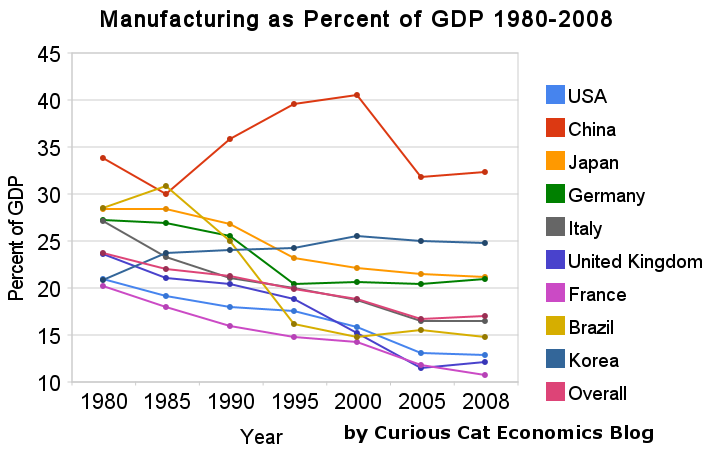
I think our government needs to establish, as a long-term priority, that we return to at least 1980 manufacturing levels (22% of GDP). It would be healthy if something in the neighborhood of 25% of our GDP was manufacturing based. Historically, our middle class was healthier when we had such levels. So, yes, I favor tax incentives for the creation and maintenance of manufacturing jobs. One thing I see in my job every day is how essential small business is to our overall economy. It is why I chose to specialize in restructuring smaller businesses. I believe the tax incentives are best given to small and mid-size manufacturers, because these are the businesses which truly drive our economy. In our "new" world marketplace, big businesses are always going to try to find the cheapest labor, but smaller businesses do not have the option to manufacture overseas.
Last edited by JoltinJoe on Thu Apr 24, 2014 5:46 am, edited 2 times in total.
-
kalm
- Supporter
- Posts: 69973
- Joined: Thu Oct 01, 2009 3:36 pm
- I am a fan of: Eastern
- A.K.A.: Humus The Proud
- Location: Northern Palouse
Re: We're #1!...
Like we've agreed upon, economics is complex. Again, we are losing ground to countries like Sweden where they choose to provide greater subsidies for things like education, child care, healthcare, etc. They fund these things through higher taxes across the board. Their system seems to be doing no worse and in some respects better than ours. Of course my friend CID will remind me that we also choose to fund our military at a much greater degree. Complex indeed.OL FU wrote:kalm wrote:
Again, fully agreeing there are multiple factors (dot.com boom anyone?), but Clinton raised taxes on the rich, created more jobs than Reagan and Bush 1 combined, and lowered the deficit.
Back to the original article and regardless, our middle class is getting passed up by countries who tax the wealthy and corporations at a higher effective rate, while spending more on educational and child care subsidies, and regulating industries at least equal if not more. I'm really not too worried about our top 10%…they'll find a way to squeak by. But I agree with Joltin Joe and others that we need to find ways to boost the middle class.
and Clinton lowered capital gains which effectively lowered the very wealthy marginal tax rate. And I too agree that manufacturing losses are the main contributor. But my point was that lower middle incomes has absolultely nothing to do with lower marginal tax rates on the rich.
I'd also point to the possibility that higher income taxes incentivize business owners to invest back into the company rather than give it up to the government which isn't a bad thing.
-
OL FU
- Level3
- Posts: 4336
- Joined: Mon Jul 16, 2007 12:25 pm
- I am a fan of: Furman
- Location: Greenville SC
Re: We're #1!...
And I agree with Kalm, I don't want to use the tax code to incent with respect to specific behavior. We have way to much of that now.


Re: We're #1!...
Kalm is right, again.
Re: We're #1!...
Target manufacturing incentives to smaller and mid-sized US businesses, since they do not have the option to manufacture overseas.OL FU wrote:I am not sure what we do about labor costs since globalization other than wait for countries to catch up which they seem to be doing. I do know that we could make investment in this country cheaper with less regulations.
-
OL FU
- Level3
- Posts: 4336
- Joined: Mon Jul 16, 2007 12:25 pm
- I am a fan of: Furman
- Location: Greenville SC
Re: We're #1!...
I don't have a problem with anything that you said until you get to the last sentence. That later. I do think we have our priorities in the wrong place many times. I do believe we should tell the Swedes and the Germans and the Italians and whoever else, while you aren't alone you have to establish your own defense first. We aren't spending all our money on your defense any longer.kalm wrote:Like we've agreed upon, economics is complex. Again, we are losing ground to countries like Sweden where they choose to provide greater subsidies for things like education, child care, healthcare, etc. They fund these things through higher taxes across the board. Their system seems to be doing no worse and in some respects better than ours. Of course my friend CID will remind me that we also choose to fund our military at a much greater degree. Complex indeed.OL FU wrote:
and Clinton lowered capital gains which effectively lowered the very wealthy marginal tax rate. And I too agree that manufacturing losses are the main contributor. But my point was that lower middle incomes has absolultely nothing to do with lower marginal tax rates on the rich.
I'd also point to the possibility that higher income taxes incentivize business owners to invest back into the company rather than give it up to the government which isn't a bad thing.
To the last point, Earning are taxed. If you tax earnings more, there is less to re-invest. So that doesn't work unless you are going to use Joe's plan to give tax credits for such investment.
Re: We're #1!...
JoltinJoe wrote:Target manufacturing incentives to smaller and mid-sized US businesses, since they do not have the option to manufacture overseas.OL FU wrote:I am not sure what we do about labor costs since globalization other than wait for countries to catch up which they seem to be doing. I do know that we could make investment in this country cheaper with less regulations.

Re: We're #1!...
As long as the tax code gives incentives to activity which is in the general best interest of our economy, and not for special interests, there is nothing wrong with using the tax code as a tool of public policy, IMO.OL FU wrote:And I agree with Kalm, I don't want to use the tax code to incent with respect to specific behavior. We have way to much of that now.
Re: We're #1!...
D1B wrote:JoltinJoe wrote:
Target manufacturing incentives to smaller and mid-sized US businesses, since they do not have the option to manufacture overseas.

Dude, this conversation is way over your head.
I mean, one minute you're citing to Karl Marx, the next minute you're mocking me for suggesting that the tax code can be used appropriately to influence favored economic activity.
-
OL FU
- Level3
- Posts: 4336
- Joined: Mon Jul 16, 2007 12:25 pm
- I am a fan of: Furman
- Location: Greenville SC
Re: We're #1!...
The problem is there is no way to control it. I agree we have it now but what is in the best interest of the economy as we can see from our discussion here is not something that people tend to agree on. So we give the tax credit to small manufacturers, then we give the credit to start ups promoting green energy, then we give the credit so individuals will buy newer high gas mileage automobiles, then we give the credit for people to grow corn for ethanol, then we give the credit for people who feed turtles, then we give the credit to people that don't feed turtles.JoltinJoe wrote:As long as the tax code gives incentives to activity which is in the general best interest of our economy, and not for special interests, there is nothing wrong with using the tax code as a tool of public policy, IMO.OL FU wrote:And I agree with Kalm, I don't want to use the tax code to incent with respect to specific behavior. We have way to much of that now.
I understand your point and unfortunately we will never do this differently. But the easiest way to solve that problem is end provisions in the tax code that incentivise behavior.
-
mrklean

- Level3
- Posts: 3794
- Joined: Tue Jul 31, 2007 11:06 am
- I am a fan of: Georgia Southern Uni.
- Location: Stockbridge, GA
Re: We're #1!...
Do we still have a working Middle Class?AZGrizFan wrote:Our middle class today looks NOTHING like the middle class of 20, 30 or 40 years ago. Today's middle class would be looked at as 1%'ers by the middle class of 1965.


FROM DA DURTY SOUTH!
Re: We're #1!...
JoltinJoe wrote:D1B wrote:
Dude, this conversation is way over your head.
I mean, one minute you're citing to Karl Marx, the next minute you're mocking me for suggesting that the tax code can be used appropriately to influence favored economic activity.
You're losing this argument too.
Call Firdham and get a refund.
Re: We're #1!...
I agree with your point that it is no solution to tax the investor class more heavily. But I would like to provide them with reasons to invest in US manufacturing businesses rather than overseas manufacturing.OL FU wrote:The problem is there is no way to control it. I agree we have it now but what is in the best interest of the economy as we can see from our discussion here is not something that people tend to agree on. So we give the tax credit to small manufacturers, then we give the credit to start ups promoting green energy, then we give the credit so individuals will buy newer high gas mileage automobiles, then we give the credit for people to grow corn for ethanol, then we give the credit for people who feed turtles, then we give the credit to people that don't feed turtles.JoltinJoe wrote:
As long as the tax code gives incentives to activity which is in the general best interest of our economy, and not for special interests, there is nothing wrong with using the tax code as a tool of public policy, IMO.
I understand your point and unfortunately we will never do this differently. But the easiest way to solve that problem is end provisions in the tax code that incentivise behavior.
The reality is that the nearly 10 percentage point drop in manufacturing as a component of GDP has been matched with a 10 percent increase in spending as a component of GDP, over the past 30 years. And that's the tale of the tape. Investment is the province of the upper class; manufacturing is the province of the middle class. When consumer purchasing becomes a more significant component of the GDP, the investor class benefits because people are buying products and services provided by businesses in which the investor class is invested. So that explains, at least in part, why the investor class is prospering over the relevant time line. But why is the middle class treading water? Because (at least in significant part) manufacturing's historical component of the GDP is being replaced by spending as a component of the GDP.
I have no beef with a prospering investor class. But I'd like to see them prosper more in US investments.
Can we control it? To some extent, with mild regulatory and tax code policy adjustments, yes, I think so. But I agree that it is not easy to do without a true bi-partisan effort. I suspect your fear is that in trying to "control" and encourage manufacturing growth, we would become too much like a centralized economy.
Yes, no easy answers. But I do throw out there that our middle class was more stable when manufacturing was in the range of 25% of our GDP. And I'd like to see us get back to the point.
A healthy economy MAKES things.
Re: We're #1!...
Oh if we could do such a thing.JoltinJoe wrote:As long as the tax code gives incentives to activity which is in the general best interest of our economy, and not for special interests, there is nothing wrong with using the tax code as a tool of public policy, IMO.OL FU wrote:And I agree with Kalm, I don't want to use the tax code to incent with respect to specific behavior. We have way to much of that now.
Politicians of every stripe use the tax code and their ability to alter the tax code at their whim to buy votes. Until that ends, it doesn't really matter what reforms are put in place.
Re: We're #1!...
Absolutely, I agree.Baldy wrote:Oh if we could do such a thing.JoltinJoe wrote:
As long as the tax code gives incentives to activity which is in the general best interest of our economy, and not for special interests, there is nothing wrong with using the tax code as a tool of public policy, IMO.
Politicians of every stripe use the tax code and their ability to alter the tax code at their whim to buy votes. Until that ends, it doesn't really matter what reforms are put in place.
There is a big difference between what SHOULD be done, and what WILL be done. I don't have any illusions that what SHOULD be done will actually be done.

-
OL FU
- Level3
- Posts: 4336
- Joined: Mon Jul 16, 2007 12:25 pm
- I am a fan of: Furman
- Location: Greenville SC
Re: We're #1!...
JoltinJoe wrote:Absolutely, I agree.Baldy wrote: Oh if we could do such a thing.
Politicians of every stripe use the tax code and their ability to alter the tax code at their whim to buy votes. Until that ends, it doesn't really matter what reforms are put in place.
There is a big difference between what SHOULD be done, and what WILL be done. I don't have any illusions that what SHOULD be done will actually be done.
and I think that was really my point. It is a little like earmarks. There were some good earmarks and way too many more bad earmarks. The only way to control it was to stop them, period. The tax provisions to incent behavior is way out of control. Certainly there are some good ones. But the only way to stop the tremendous number of bad ones is to stop all of them. But I don't see that happening.