He and I have been arguing this for 7 years now - I wan't gas to hit 8 bucks a gallon - come on baby GO..!!!










Chizzang wrote:Where is T-man
He and I have been arguing this for 7 years now - I wan't gas to hit 8 bucks a gallon - come on baby GO..!!!


It's not very sustainable if you're in Alaska in the winter.Ibanez wrote:Solar power is everywhere in Germany. Down to the little farms, as you exit Munich. Each house has panels on the roof, even moreso in the country side. Driving from Germany to France, you'll drive for miles passing huge Wind Turbine fields. They obviously know something we don't (or that we ignore). Nonetheless, fossil fuels are not sustainable. Solar Energy is (until the sun engulfs us).

You don't think the supply of oil has been subsidized?CitadelGrad wrote:So you want to subsidize supply without addressing demand? Not a great idea. Don't they teach econ at Harvard? I'm pretty sure they do, because I read a couple of Harvard econ profs' blogs every day.


Yep- that shows that wanting to be like Germany is pretty retarded.HI54UNI wrote:Avg residential rate in the US - 11.8 cents/kwh
Avg rate in Germany - 36.48 cents/kwh
Avg residential use in the USA is about 12,000 kwh/year
12,000 x 0.118 = $1,416
12,000 x 0.3648 = $4,377.60
Difference $2,961.60
Looks like I'm a lot better off paying the supposed fossil fuel subsidy.


Baldy wrote:It's not very sustainable if you're in Alaska in the winter.Ibanez wrote:Solar power is everywhere in Germany. Down to the little farms, as you exit Munich. Each house has panels on the roof, even moreso in the country side. Driving from Germany to France, you'll drive for miles passing huge Wind Turbine fields. They obviously know something we don't (or that we ignore). Nonetheless, fossil fuels are not sustainable. Solar Energy is (until the sun engulfs us).
Anyway, there is enough fossil fuel in the US alone to sustain this country for 200 more years. Maybe by then solar, wind, and biofuels will be more efficient and affordable.
If you are a country or state that must import fuel (Japan, USA, Germany, Hawai'i) the savings could be tremendous if you were able to utilize solar power. Alaskans could benefit from cheaper renewable energy, especially since they spend the most on energy than any other state. Wyoming comes in number 2. Converesly, Wyoming uses the most energy with Alaska right behind them. No system is perfect and as of yet, the steady baseload that nuclear provides isn't seen in solar power. Everything has it's pros and cons.Germany has long been the world leader in producing solar electricity, in large measure because over a decade ago it implemented “feed in tariffs” (FiTs) that essentially pay people and businesses for generating solar.
Germany has been cutting those tariffs steadily, and at an accelerating pace as plunging prices of solar panels makes them less necessary. The FiTs have encouraged solar uptake and have led to lower prices through manufacturing economies of scale. On top of that, Chinese manufacturers have pushed prices down.
German’s Parliament recently sped up FiT cuts in part because the subsidy has led to higher electricity prices


andy7171 wrote:Looks like cleats will be hanging out over at AGS for a couple weeks while this thread is forgotten.


I think there's a direct correlation to the state of the economy in your chart. Folks are driving less, lower demand for gasoline overall, and we're using a higher percentage of US capacity to fill the needs of those who are driving.Ibanez wrote:Baldy wrote:It's not very sustainable if you're in Alaska in the winter.
Anyway, there is enough fossil fuel in the US alone to sustain this country for 200 more years. Maybe by then solar, wind, and biofuels will be more efficient and affordable.
http://www.smartplanet.com/blog/intelli ... h-pv/16354" onclick="window.open(this.href);return false;
No system is perfect and as of yet, the steady baseload that nuclear provides isn't seen in solar power. Everything has it's pros and cons.Germany has long been the world leader in producing solar electricity, in large measure because over a decade ago it implemented “feed in tariffs” (FiTs) that essentially pay people and businesses for generating solar.
Germany has been cutting those tariffs steadily, and at an accelerating pace as plunging prices of solar panels makes them less necessary. The FiTs have encouraged solar uptake and have led to lower prices through manufacturing economies of scale. On top of that, Chinese manufacturers have pushed prices down.
German’s Parliament recently sped up FiT cuts in part because the subsidy has led to higher electricity prices
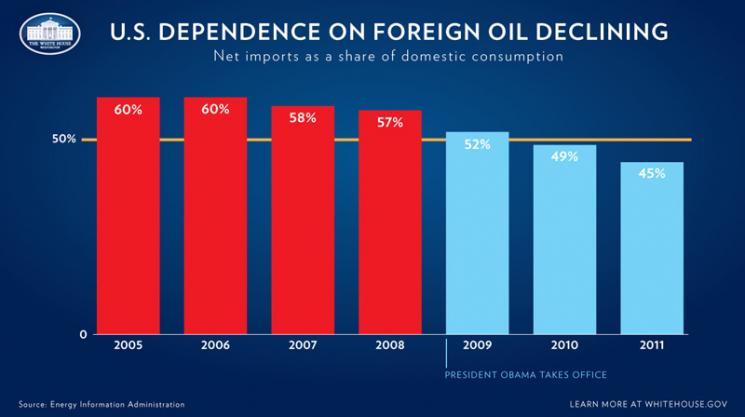
I will give the US credit, according to the Dept. of Energy, we are reducing our dependence on foreign oil.
http://energy.gov/articles/our-dependen ... -declining" onclick="window.open(this.href);return false;


Don't forget about tougher fuel economy standards imposed by the evil federal government.ASUG8 wrote:I think there's a direct correlation to the state of the economy in your chart. Folks are driving less, lower demand for gasoline overall, and we're using a higher percentage of US capacity to fill the needs of those who are driving.Ibanez wrote:
http://www.smartplanet.com/blog/intelli ... h-pv/16354" onclick="window.open(this.href);return false;
No system is perfect and as of yet, the steady baseload that nuclear provides isn't seen in solar power. Everything has it's pros and cons.
I will give the US credit, according to the Dept. of Energy, we are reducing our dependence on foreign oil.
http://energy.gov/articles/our-dependen ... -declining" onclick="window.open(this.href);return false;
Why are you and others ignoring the article Ibanez posted? Yes, Germany is cutting solar subsidies, but it's not because the industry is failing, like you're trying to portray.HI54UNI wrote:Bump
Saw Chizz was in the forum and didn't want him to forget about this one.
Actually, the German solar industry has collapsed to the point where many are calling for the industry to be nationalized before it totally disappears.Grizalltheway wrote:Why are you and others ignoring the article Ibanez posted? Yes, Germany is cutting solar subsidies, but it's not because the industry is failing, like you're trying to portray.HI54UNI wrote:Bump
Saw Chizz was in the forum and didn't want him to forget about this one.

National Solarism? Only in Germany.Baldy wrote:Actually, the German solar industry has collapsed to the point where many are calling for the industry to be nationalized before it totally disappears.Grizalltheway wrote:
Why are you and others ignoring the article Ibanez posted? Yes, Germany is cutting solar subsidies, but it's not because the industry is failing, like you're trying to portray.
let's see some sources.Baldy wrote:Actually, the German solar industry has collapsed to the point where many are calling for the industry to be nationalized before it totally disappears.Grizalltheway wrote:
Why are you and others ignoring the article Ibanez posted? Yes, Germany is cutting solar subsidies, but it's not because the industry is failing, like you're trying to portray.
Jawohl! Tomorrow belongs to sun!BlueHen86 wrote:National Solarism? Only in Germany.Baldy wrote:
Actually, the German solar industry has collapsed to the point where many are calling for the industry to be nationalized before it totally disappears.

