One Serious Question for D1B
Posted: Fri Jun 29, 2012 5:31 pm
Do you believe in the power of prayer?
I'm just a mainline Protestant, but I've seen it work.
I'm just a mainline Protestant, but I've seen it work.
FCS Football | Message Board | News
https://www.championshipsubdivision.com/forums/
https://www.championshipsubdivision.com/forums/viewtopic.php?f=10&t=30904
Yes I do. It provides power for the powerless and hope for the hopeless. In very tough times, the belief that there's an all powerful being that's capable of answering has got to be very comforting.Ivytalk wrote:Do you believe in the power of prayer?
I'm just a mainline Protestant, but I've seen it work.
D1B wrote:Yes I do. It provides power for the powerless and hope for the hopeless. In very tough times, the belief that there's an all powerful being that's capable of answering has got to be very comforting.Ivytalk wrote:Do you believe in the power of prayer?
I'm just a mainline Protestant, but I've seen it work.
Prayer is a form of meditation. A human who believes he is communicating with his particular god experiences great physical and psychological comfort as does the person who knows many are praying on their behalf. I believe it's possible to achieve very high states of consciousness through prayer and meditation and other methods. I believe cures for some of our worst diseases involve manipulating consciousness.
Absolutely, I believe in the power of prayer. Some of the healthiest, brightest, most successful and happiest people I know are very religious and espouse the power of prayer. Those fuckers.

Interesting ... so man, the most evolved and rational of the earth's creatures, "can achieve very high states of consciousness" and even obtain "cures for some of our worst diseases" by deluding himself.D1B wrote:Yes I do. It provides power for the powerless and hope for the hopeless. In very tough times, the belief that there's an all powerful being that's capable of answering has got to be very comforting.Ivytalk wrote:Do you believe in the power of prayer?
I'm just a mainline Protestant, but I've seen it work.
Prayer is a form of meditation. A human who believes he is communicating with his particular god experiences great physical and psychological comfort as does the person who knows many are praying on their behalf. I believe it's possible to achieve very high states of consciousness through prayer and meditation and other methods. I believe cures for some of our worst diseases involve manipulating consciousness.
Absolutely, I believe in the power of prayer. Some of the healthiest, brightest, most successful and happiest people I know are very religious and espouse the power of prayer. Those ****.
Fair point. I was thinking bout people caught up in disasters and such. Prayer/belief in a protector is very powerful, and I dare say necessary. I've never been in such a situation, but you know what I mean.JoltinJoe wrote:Interesting ... so man, the most evolved and rational of the earth's creatures, "can achieve very high states of consciousness" and even obtain "cures for some of our worst diseases" by deluding himself.D1B wrote:
Yes I do. It provides power for the powerless and hope for the hopeless. In very tough times, the belief that there's an all powerful being that's capable of answering has got to be very comforting.
Prayer is a form of meditation. A human who believes he is communicating with his particular god experiences great physical and psychological comfort as does the person who knows many are praying on their behalf. I believe it's possible to achieve very high states of consciousness through prayer and meditation and other methods. I believe cures for some of our worst diseases involve manipulating consciousness.
Absolutely, I believe in the power of prayer. Some of the healthiest, brightest, most successful and happiest people I know are very religious and espouse the power of prayer. Those ****.
In some respects, this is a very thoughtful answer and in other ways it is riddled with contradiction. That contradiction should give reason to reconsider your assumption that prayer is a delusion for the "powerless" and "hopeless."
 When LSD was easy to get, I'd take it and reap the same benefits for months afterwards. It's too bad this wonderful drug was vilified. It's one of those divine gifts that trigger the brain to do amazing things, including cure disease.
 The human brain is capable of amazing things. It's a veritable divine pharmacy.SeattleGriz wrote:D1B wrote:
Yes I do. It provides power for the powerless and hope for the hopeless. In very tough times, the belief that there's an all powerful being that's capable of answering has got to be very comforting.
Prayer is a form of meditation. A human who believes he is communicating with his particular god experiences great physical and psychological comfort as does the person who knows many are praying on their behalf. I believe it's possible to achieve very high states of consciousness through prayer and meditation and other methods. I believe cures for some of our worst diseases involve manipulating consciousness.
Absolutely, I believe in the power of prayer. Some of the healthiest, brightest, most successful and happiest people I know are very religious and espouse the power of prayer. Those fuckers.
Interesting comments D1. I am of the sort that positive vibes are amazing. When science now talks about how cells can communicate, why is it so hard to believe sending good thoughts a person's way is not beneficial?
As for prayer, I also believe that one needs to believe what they have asked for WILL happen to make prayer more powerful.

It's amazing that you would say this. Something absolutely miraculous happened while I was alone in Assisi, in front of the Basilca of St. Francis, around midnight. I had left our hotel room to see if I could get some photos of the square/basilica at night and there was no one there, at least to my recollection. When I tell people what I saw, they think I was on LSD.D1B wrote: I feel inspired, physically and emotionally after visiting an art museum or seeing a beautiful woman, reading a snippet on Euclid, watching Louie on FX, or reading about St. Francis of Assisi, who I believe was the best catholic.
I think I would have a similar experience inside the basilica where the world's greatest renaissance painters left their mark. This and other churches in Italy are ground zero repositories for all of western art, perhaps the most important being Giotto.JoltinJoe wrote:It's amazing that you would say this. Something absolutely miraculous happened while I was alone in Assisi, in front of the Basilca of St. Francis, around midnight. I had left our hotel room to see if I could get some photos of the square/basilica at night and there was no one there, at least to my recollection. When I tell people what I saw, they think I was on LSD.D1B wrote: I feel inspired, physically and emotionally after visiting an art museum or seeing a beautiful woman, reading a snippet on Euclid, watching Louie on FX, or reading about St. Francis of Assisi, who I believe was the best catholic.
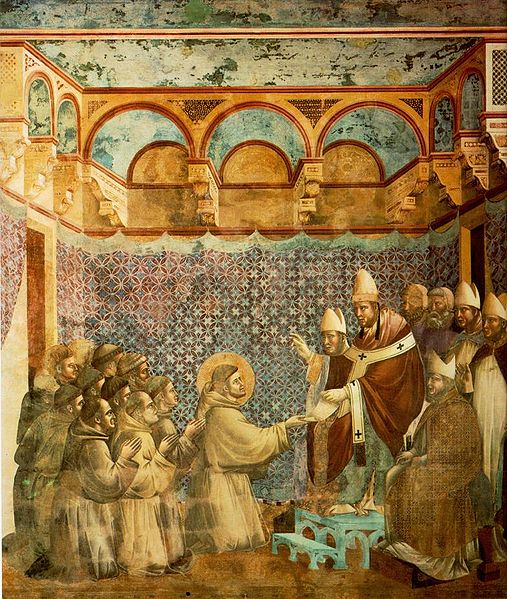
Giotto di Bondone (1266/7 – January 8, 1337), better known simply as Giotto, was an Italian painter and architect from Florence in the late Middle Ages. He is generally considered the first in a line of great artists who contributed to the Italian Renaissance.
Giotto's contemporary the banker and chronicler, Giovanni Villani, wrote that Giotto was "the most sovereign master of painting in his time, who drew all his figures and their postures according to nature. And he was given a salary by the Comune of Florence in virtue of his talent and excellence."[1]
The late-16th century biographer Giorgio Vasari describes Giotto as making a decisive break with the prevalent Byzantine style and as initiating "the great art of painting as we know it today, introducing the technique of drawing accurately from life, which had been neglected for more than two hundred years."[2]
Giotto's masterwork is the decoration of the Scrovegni Chapel in Padua, also known as the Arena Chapel, completed around 1305. This fresco cycle depicts the life of the Virgin and the life of Christ. It is regarded as one of the supreme masterpieces of the Early Renaissance.[3] That Giotto painted the Arena Chapel and that he was chosen by the Comune of Florence in 1334 to design the new campanile (bell tower) of the Florence Cathedral are among the few certainties of his biography. Almost every other aspect of it is subject to controversy: his birthdate, his birthplace, his appearance, his apprenticeship, the order in which he created his works, whether or not he painted the famous frescoes at Assisi, and his burial place.
I look forward to visiting the great catholic basilicas.JoltinJoe wrote:Unfortunately when we were there many of the Giotto frescos were still being repaired. They had been severely damaged in the 1997 earthquake and were being painstakingly restored piece by piece. Many parts of the interior of the basilica were off limits. Also flash photography was prohibited and there was not enough interior light to photograph any of the artworks without a tripod (which I didn't have). Still, we were able to attend a Mass there, which was pretty amazing. People from all over the world saying the Mass in their native tongue. It all blended together as if a musical tune.
http://sdicht.files.wordpress.com/2010/ ... -pages.pdf" onclick="window.open(this.href);return false;He also begins his early elaboration of truth and metaphor “On Truth and Lie in an Extra-
Moral Sense” with a fable that shows a world before and after the “invention” of
abstraction – akin to the Dawn of Man – and illustrates the insignificance of the human in
the vastness of space, a motif that comes across in a great many moments in 2001.
Nietzsche’s own view of evolution was, as he stated in Twilight of the Idols, “anti-
Darwinistic”, posing evolution in terms that are not merely biological or natural.His
view is close to Kubrick’s in 2001 in that the group of apes that learn how to use the tool
are apparently biologically the same as another group of apes. What changes is that one
group has come in contact with the monolith, which, in turn, has sparked in them a need
to solve this problem of “procreation and nourishment,” since they are starving and being
eaten by predators. Hence, they triumph over their competitors, having now the mental
ability to make the world congenial to their needs through abstraction and will-to-power,
and it is through artifice that the selection will take place.
We immediately see the results of this move towards abstraction and logic, moving
millions of years in the future to the year 2001, where man has dominated Earth and its
immediate surroundings with his structures, populating the Earth’s orbit with satellites,
space stations and moving spacecraft. In the foreground is the interaction between man
and his space (inner and outer), the signs and formulas man has invented to achieve a
purposeful, useful scheme. Technology itself seems to be more important, and even more
interesting, than the people inhabiting their spaces and operating their controls. They are
seen as diminutive and passive in these sequences, seen either sleeping or working at a
distance (both physical and perceptual), secondary to their instruments. In this future, it is
the machines that dominate screen space. Additionally, there is little sense of aesthetics
apart from that of functionality: all the space machinery, both outside and inside (through
décor) is extremely beautiful and stylized, but no one seems to acknowledge or care,
since aesthetics, in the world of 2001, no longer serves a function of its own, and is
reduced only to accompany function. Nietzsche’s description of mankind in “Truth and
Lie” is hauntingly close to what Kubrick depicts: a world of mere surface and
appearances: “they are deeply immersed in illusions … their eyes merely glide across the
surface of things and see forms…”11 Kubrick’s use of the highly formal The Blue
Danube, by Johann Strauss, heightens this sense of appearances, its circular structure and
regular compass denoting order and fluidity, while still pertaining to a sense of spectacle
by the juxtaposition of the spectacular images, perhaps even suggesting that even the
extraordinary (for us) actions of moving about through space is only one more aspect of
man’s social scheme: no wonder all conversations and human interactions are nothing but
the exchange of formalities and speeches without real content.
I visited many in Germany and France and to this day am amazed at those beauty. There is an amazing cathedral in Asheville,NC. I'll find the link, it's breathtaking.D1B wrote:I look forward to visiting the great catholic basilicas.JoltinJoe wrote:Unfortunately when we were there many of the Giotto frescos were still being repaired. They had been severely damaged in the 1997 earthquake and were being painstakingly restored piece by piece. Many parts of the interior of the basilica were off limits. Also flash photography was prohibited and there was not enough interior light to photograph any of the artworks without a tripod (which I didn't have). Still, we were able to attend a Mass there, which was pretty amazing. People from all over the world saying the Mass in their native tongue. It all blended together as if a musical tune.
When I was pup, my parents were struggling to keep me in the faith and make sure I attended mass. I struck a deal with them that would allow me and my high school girlfriend to attend mass at the church of our choice. We made the rounds of all the great churches in Chicago, many in the very catholic Polish and Lithuanian neighborhoods. What beautiful buildings and art meant to awe and inspire. Massed were done in native tongue too. IMO, there are few Catholics that rival the Polish and Lithuanians in strength of faith and love for the church.
Those areas never id'd anyone at the bars. We end up at a smokey old tavern and drinks thousands of Budweisers, get high in the alley, and listen to old men tell war stories.
Do you see 93henfan there?Ibanez wrote:Jeff, have you been to the MOMA in NYC? I'm not a fan of most modern art, but I loved going there when it was free on Fridays.
Ha. Good one.
Yes, us East Coasters are highly cultured.grizzaholic wrote:Do you see 93henfan there?Ibanez wrote:Jeff, have you been to the MOMA in NYC? I'm not a fan of most modern art, but I loved going there when it was free on Fridays.
Ha. Good one.
While Kubrick's film was brilliant, I wasn't a huge fan of its message and it has been a long time since I saw it, so I'd hesitate to speak about it.D1B wrote:What do you guys think of Kubrick's/Clarke's 2001 A Space Odyssey?
Joe, I'm particularly interested in your thoughts on the themes: Kubricks portrayal of "God", The dawn of man - "the first human" and Nietzsche's/ Shoepenhaeur's concepts of Will to Power and the nature of truth. I can not get through Thus Spoke Zarathustra - just aint smart or patient enough, but Kubrick seems to have it down and It comes very close to what I think is goin on and perhaps what went on.
Here's part of an excellent analysis, IMO.
http://sdicht.files.wordpress.com/2010/ ... -pages.pdf" onclick="window.open(this.href);return false;He also begins his early elaboration of truth and metaphor “On Truth and Lie in an Extra-
Moral Sense” with a fable that shows a world before and after the “invention” of
abstraction – akin to the Dawn of Man – and illustrates the insignificance of the human in
the vastness of space, a motif that comes across in a great many moments in 2001.
Nietzsche’s own view of evolution was, as he stated in Twilight of the Idols, “anti-
Darwinistic”, posing evolution in terms that are not merely biological or natural.His
view is close to Kubrick’s in 2001 in that the group of apes that learn how to use the tool
are apparently biologically the same as another group of apes. What changes is that one
group has come in contact with the monolith, which, in turn, has sparked in them a need
to solve this problem of “procreation and nourishment,” since they are starving and being
eaten by predators. Hence, they triumph over their competitors, having now the mental
ability to make the world congenial to their needs through abstraction and will-to-power,
and it is through artifice that the selection will take place.
We immediately see the results of this move towards abstraction and logic, moving
millions of years in the future to the year 2001, where man has dominated Earth and its
immediate surroundings with his structures, populating the Earth’s orbit with satellites,
space stations and moving spacecraft. In the foreground is the interaction between man
and his space (inner and outer), the signs and formulas man has invented to achieve a
purposeful, useful scheme. Technology itself seems to be more important, and even more
interesting, than the people inhabiting their spaces and operating their controls. They are
seen as diminutive and passive in these sequences, seen either sleeping or working at a
distance (both physical and perceptual), secondary to their instruments. In this future, it is
the machines that dominate screen space. Additionally, there is little sense of aesthetics
apart from that of functionality: all the space machinery, both outside and inside (through
décor) is extremely beautiful and stylized, but no one seems to acknowledge or care,
since aesthetics, in the world of 2001, no longer serves a function of its own, and is
reduced only to accompany function. Nietzsche’s description of mankind in “Truth and
Lie” is hauntingly close to what Kubrick depicts: a world of mere surface and
appearances: “they are deeply immersed in illusions … their eyes merely glide across the
surface of things and see forms…”11 Kubrick’s use of the highly formal The Blue
Danube, by Johann Strauss, heightens this sense of appearances, its circular structure and
regular compass denoting order and fluidity, while still pertaining to a sense of spectacle
by the juxtaposition of the spectacular images, perhaps even suggesting that even the
extraordinary (for us) actions of moving about through space is only one more aspect of
man’s social scheme: no wonder all conversations and human interactions are nothing but
the exchange of formalities and speeches without real content.
Better than the Guggenheim. Waste of time and money.Ibanez wrote:Jeff, have you been to the MOMA in NYC? I'm not a fan of most modern art, but I loved going there when it was free on Fridays.
Ha. Good one.

I haven't been to the Guggenheim. The Louvre and Musea de Orsy in Paris are wonderful. I prefer the latter.Grizalltheway wrote:Better than the Guggenheim. Waste of time and money.Ibanez wrote:Jeff, have you been to the MOMA in NYC? I'm not a fan of most modern art, but I loved going there when it was free on Fridays.
Ha. Good one.
Favorite that I've been to was probably the Hungarian National Gallery in Budapest. Huge collection, and you can't beat the location.Ibanez wrote:I haven't been to the Guggenheim. The Louvre and Musea de Orsy in Paris are wonderful. I prefer the latter.Grizalltheway wrote:
Better than the Guggenheim. Waste of time and money.
Ha. Good one.


yeah? I'll have to make a trip out there. In returning to Germany in the spring for about 2 weeks, perhaps I can find my way there.Grizalltheway wrote:Favorite that I've been to was probably the Hungarian National Gallery in Budapest. Huge collection, and you can't beat the location.Ibanez wrote: I haven't been to the Guggenheim. The Louvre and Musea de Orsy in Paris are wonderful. I prefer the latter.
Ha. Good one.
God, I feel so Bohemian.